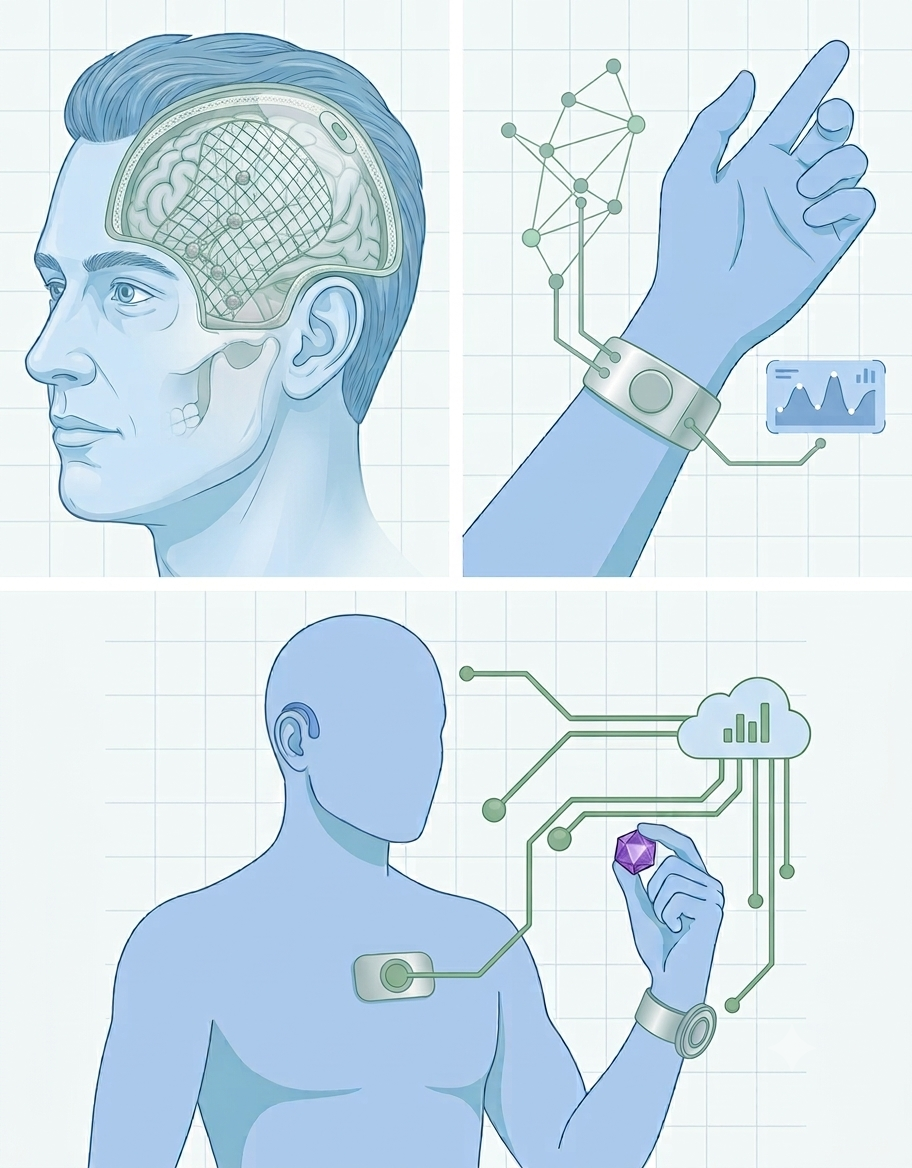
We operate at the interface of electrical engineering, biomedical engineering, and clinical translation, focusing on the technologies that let wearable and implantable medical devices work reliably outside the laboratory: communications, data, security, power, and system-level integration.
Many promising bioelectronic devices fail not because the sensor is inadequate, but because the supporting infrastructure is underdeveloped. We treat sensing, computation, wireless communication, and power management as a single co-designed system, which lets us address autonomy, data integrity, latency, privacy, and robustness from the outset rather than as afterthoughts.
This plays out across two main application areas. In neurotechnology, we develop architectures for acquiring, compressing, transmitting, and securely handling high-throughput neural data, built for low-latency, low-power operation on wearable and implantable platforms. In parallel, we work with clinical wearable datasets for monitoring stress, pain, and neurological conditions, where data quality, synchronisation, annotation, and explainability matter as much as the sensing hardware itself. Both areas act as scientific drivers and as realistic testbeds for the technologies we build.
Technically, the group builds complete electronic and computational stacks: analogue front ends for biopotential and biosignal acquisition, embedded and mixed-signal electronics for sensor interfacing, low-power wireless backends, and firmware spanning device, gateway, and edge processing. Power-aware design runs throughout, from ultra-low-power architectures to duty-cycled, energy-constrained computation. Security and data governance are design constraints, not afterthoughts, especially for systems intended for clinical deployment.
Clinical translation defines the group's philosophy. We work with clinicians and translational researchers to keep engineering decisions grounded in real clinical workflows, regulatory constraints, and patient needs, with the aim of moving platforms from proof-of-concept towards clinical studies and real-world deployment.